The vitamin was given the designation ‘K’ when, around 1935, the Danish researcher Henrik Dam isolated a fat-soluble substance that had a regulating effect on blood clotting – the ‘coagulation vitamin’. Today, vitamin K is understood to refer to a family of fat-soluble vitamins – K1 to K4.
Following the award of the Nobel Prize in Medicine for the discovery of vitamin K to the researchers Dam and Edward Adelbert Doisy, the focus of research shifted predominantly to blood clotting function. Menaquinone (vitamin K2) initially received little attention. Over the past 15 years, the number of research studies on vitamin K2 has risen significantly. Several groundbreaking studies have been published, particularly regarding bone and cardiovascular health.
The Structure
A naphthoquinone ring forms the basic structure of all vitamin K compounds. These differ from one another in their side chains. Menachinones are distinguished by the length of their side chains. MK-4 has four isoprenoid units and MK-7 has seven. The side chain must be in the trans configuration for the vitamin to be biologically active in the body.

Function in the body
Vitamin K2 plays a role in maintaining calcium balance in the body. It ensures that calcium is deposited in the bones rather than in the blood vessel walls. Vitamin K2 MK-7 acts as a co-factor in the activation of calcium-binding proteins such as matrix Gla protein (MGP) in blood vessel walls and osteocalcin (OC) in the bones, enabling the protein to incorporate calcium into the bone structure. Inactive osteocalcin is unable to do this. There are significant differences in absorption, transport in the blood and tissue distribution. A key difference between vitamin K1, vitamin K2 MK-4 and MK-7 is their vastly different half-lives. All these vitamins are efficiently absorbed in the presence of fat; however, the concentration of both MK-4 and vitamin K1 in the bloodstream decreases very rapidly after ingestion. The reason for this is the short half-life of MK-4 and vitamin K1, which is approximately 1 to 2 hours. MK-7, on the other hand, has a much longer half-life of 2 to 3 days. Other menaquinones such as MK-9 have a long half-life, but are not absorbed as efficiently, and their ability to act as a co-factor in the activation of the aforementioned proteins is much lower compared to MK-7, MK-4 and vitamin K1.
Vitamin K in the diet
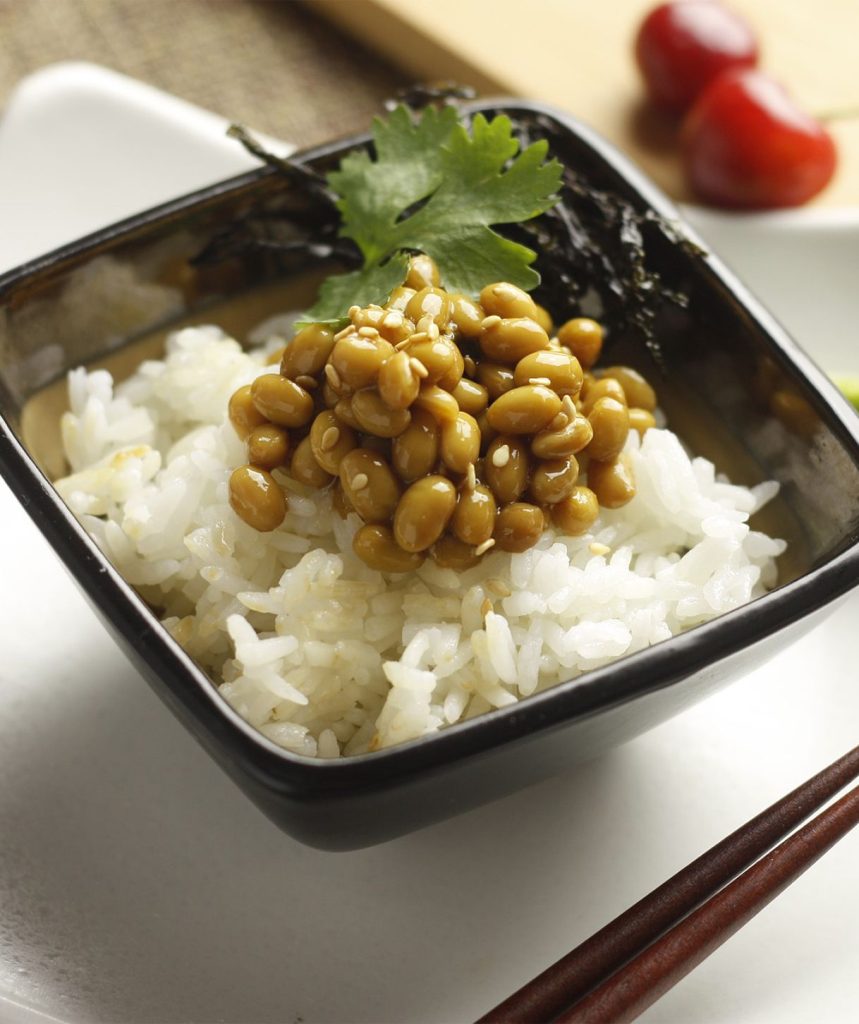
In Japanese culinary culture, a traditional dish called natto is a rich source of vitamin K2; it consists of cooked soya beans that have been fermented. This fact may also explain why the incidence of osteoporosis is much lower in Japan than in Western countries. As the Western diet contains very little MK-7, dietary supplementation is recommended for optimal support of bone health.